Showing posts with label Employment. Show all posts

Friday, May 4, 2012

Um ....

From Zero Hedge:

It is just getting sad now. In April the number of people not in the labor force rose by a whopping 522,000 from 87,897,000 to 88,419,000.  This is the highest on record. The flip side, and the reason why the unemployment dropped to 8.1% is that the labor force participation rate just dipped to a new 30 year low of 64.3%.


If anybody thinks another stimulus package might be warranted, you can find our suggestion here.

Just sayin'.

Thursday, February 9, 2012

Good News, Again

As Steve Benen at the Rachel Maddow Show blog notes, initial unemployment claims continued to dip. From the Department of Labor press release:
U.S. jobless claims fell by 15,000 to a seasonally adjusted 358,000 in the week ended Feb. 4, the Labor Department said Thursday. Economists surveyed by MarketWatch had estimated claims would rise to 370,000. Claims from two weeks ago were revised up by 6,000 to 373,000. The four-week average of claims, meanwhile, dropped by 11,000 to 366,250, the lowest level since April 2008.
And Steve provides the following helpful chart:


And Steve notes:
In terms of metrics, keep in mind, when these jobless claims fall below the 400,000 threshold, it's considered evidence of an improving jobs landscape. When the number drops below 370,000, it suggests jobs are actually being created rather quickly.
And we are finally below 370,000. All in all, this suggests that the numbers we've been seeing lately are not aberrations, but are evidence of a recovery with some legs.

For fun, we went to the St. Louis Fed to see what initial unemployment claims were under Clinton, Bush and Obama.


So clearly we have a ways to go, but it's also clear how god-awful the recession was. Clinton's initial unemployment claims peaked out at about 400,000, and Bush -- even with 9/11 didn't get much above 480,000. But Obama had to face a high of over 640,000 claims, 33% worse than Bush.

We can also see that last year's Euro crisis took quite a toll on the recovery.


We were doing OK through April, but then it took us about eight months to bounce back.

There's indirect but confirming evidence from another, and unorthodox, source. MisterMix at Balloon Juice says that this "explains why the Republican Party is ginning up the culture war—it’s easier than acknowledging that the economy is getting better."

And we think he's onto something. Fighting a war over contraception when only 2% of Catholic women rely on what is known as "natural family planning") seems ludicrous. But it does play well with the base. From the Public Religion Research Institute:


Thursday, February 2, 2012

A Little Bit More Good News

Via Calculated Risk, we learn that the Department of Labor is reporting that:
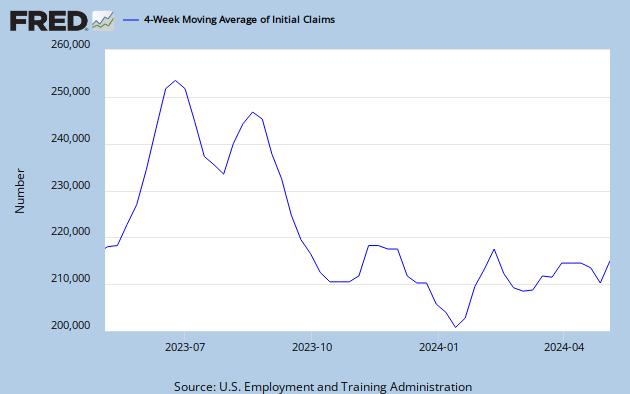
In the week ending January 28, the advance figure for seasonally adjusted initial claims was 367,000, a decrease of 12,000 from the previous week's revised figure of 379,000. The 4-week moving average was 375,750, a decrease of 2,000 from the previous week's revised average of 377,750.
And Calculated Risk helpfully provides the following graph of the four-week moving average of initial claims. 
The four-week moving average is helpful because the claims tend to bounce around a bit. A couple of weeks ago, we noted that initial claims had fallen to 352,000, which is lower than today's report of 367,000. But the moving average at that time was 379,000, and now its 375,750. As Steve Benen (then at Political Animal) noted at the time:
In terms of metrics, keep in mind, when these jobless claims fall below the 400,000 threshold, it’s considered evidence of an improving jobs landscape. When the number drops below 370,000, it suggests jobs are actually being created rather quickly.
What this means is that if -- if-- we can get a couple more weeks of improving initial unemployment claims we should -- should -- should be entering a virtuous cycle, where the economy's improving performance becomes self-reinforcing. 


And now Steve Benen (newly moved to the Maddow Blog) reports that:
In terms of metrics, keep in mind, when these jobless claims fall below the 400,000 threshold, it's considered evidence of an improving jobs landscape. When the number drops below 370,000, it suggests jobs are actually being created rather quickly.
Okay, that wasn't helpful, but it is a message that bears repeating.

Thursday, January 19, 2012

Good News, For a Change

It's beginning to look like we might be turning the economy around.

From Steve Benen at Political Animal:
The general trend on initial unemployment claims over the last two months has been largely encouraging, though there have been setbacks. Last week, for example, was a step in the wrong direction.  
This week’s report, however, was a very pleasant surprise. Initial claims not only dropped sharply, they fell to a level unseen in nearly four years. 
The number of Americans who filed requests for jobless benefits sank by 52,000 last week to 352,000, the lowest level since April 2008, the U.S. Labor Department said Thursday. Claims from two weeks ago were revised up to 402,000 from 399,000. Economists surveyed by MarketWatch had projected claims would fall to a seasonally adjusted 375,000 in the week ended Jan. 14. The average of new claims over the past four weeks, meanwhile, dropped by a much smaller 3,500 to 379,000.
In terms of metrics, keep in mind, when these jobless claims fall below the 400,000 threshold, it’s considered evidence of an improving jobs landscape. When the number drops below 370,000, it suggests jobs are actually being created rather quickly.
Steve also provides this chart tracking initial unemployment claims, and that arrow around 2009 is when Obama's stimulus package began spending money.


The Republicans have been slamming Obama's job creation record lately -- Romney has claimed that Obama has lost 2 million jobs, and Gingrich has been calling him a "food stamp president". (Bonus fun fact: Bush II had more people go on food stamps, about a half million more.)

But this graph shows quite clearly that Obama stemmed a horrific rise in initial unemployment claims, and has been -- slowly -- adding jobs ever since.


Another way to look at this would be to consider total (non-farm) employment, as Krugman did with this chart from FRED (the St. Louis Fed's wonderful collection of economic data. Jobs continue to tank once Obama took office, but once his stimulus plan was passed and dollars started moving out the door, things turned around.

Now, if the stimulus would have been bigger, the economy would have bounced back more quickly (and we still have quite a ways to go). But it's pretty hard to argue that Obama didn't stop the economic downturn and put us back on the right path.

Friday, November 18, 2011

Stimulus -- Part the Fourth

So … earlier we explained why we need a new stimulus package (to reduce unemployment) and why we just can’t rely on the private sector (it doesn’t create demand). Then we addressed the complaint that the first stimulus didn’t work (it did, but it wasn’t big enough, and the economy cratered harder than we thought). And yesterday, we tackled the question of whether we can afford another stimulus (yes, at about a third of the cost of what we spent providing air conditioning for the troops in Iraq and Afghanistan).

Now we get to the fun part, spending the money. Since we’ve already calculated the costs of a $1 trillion stimulus at $7.5 billion per annum, let’s work with that figure. Also, Krugman says the Congressional Budget Office predicted a $3 trillion hole in the economy from 2009 to 2011, and that the original stimulus was too small to address this effectively. We also know that the decline in late 2008 was much greater than we thought at the time -- an 8.9% decrease in GDP, when we thought it would be 3.7%, so $1 trillion sounds like it’s in the right neighborhood.

That sounds like a huge number, and it is. But remember that our current GDP – the one we need to improve – is around $15 trillion. Big problems require big solutions.

The stimulus plan should have three prongs, namely:
  • Compensatory aid to states,
  • Aid for infrastructure repair and
  • A little somethin’, somethin’ for the people.

Let’s start with compensatory aid for the states. State (and cities) typically have a much worse time during a recession than the federal government because they (a) can’t print their own money and (b) have to balance their budgets. So when revenues decrease, states have few options save for trimming their own expenditures.

Calculated Risk, an economics blogs, says that we’ve lost 232,000 state and city jobs so far this year. And in California, things look like they’re going to get worse. From the Huffington Post:
The analyst projected that midyear cuts would have to be made because revenue in the current fiscal year will fall $3.7 billion below the $88.4 billion the governor and state lawmakers had desired. 
The cuts to be implemented after the first of the year include up to $100 million each to the University of California, California State University, developmental services and in-home support for seniors and the disabled. Community college fees would increase $10 per unit, and reductions would be made for child care assistance, library grants and prisons, among other programs. 
Because revenue is projected to fall short by more than $2 billion, the state could cut public school funding by up to $1.4 billion, though that amount will have to be determined by Brown's finance director. Besides laying off school staff, cutting expenses and dipping into reserves, the state could allow school districts to reduce the school year by up to seven days, from 175 to 168. California had 180 school days before the recession hit.
… 
 California's unemployment rate – under 5 percent as recently as 2006 – has remained above 11 percent for more than two years.... It projects California's jobless rate will remain above 10 percent through the middle of 2014 and above 8 percent through 2017.
In short, direct aid to the states is a very efficient form of stimulus because it can prevent exactly the kinds of lay-offs and cut-backs that California is facing. Also, according to the Congressional Budget Office, they also have a relatively high multiplier effect – somewhere between 0.7 and 1.8.


So let's allot $200 billion for states and cities. That way, kids don't have to see their school years shortened by two and a half weeks.

But let's take another look at at that multiplier chart. Several things, like tax cuts, don't have very good multipliers at all (especially tax cuts for the wealthy). But there are two things with higher multiplier effects -- purchases by the federal government (which we’re not going to address, because we don't know what to suggest) and aid to states and local governments for infrastructure (which we will, because we do). Both have estimated multipliers between 1.0 and 2.5.

Why infrastructure? Aside from the multiplier, it's one of the areas where conservatives and liberals can agree. While a liberal might value infrastructure repair (and this will only be about repairs -- no new projects at all) for its Keynesian effect, a conservative might just want to get the damn thing cleaned up, especially when labor and financing costs are lower. 

And liberal economist Robert Frank and conservative satirist P.J. O'Rourke did, in fact, agree in an opinion piece for USA Today.
Our nation's infrastructure is in tatters. The American Society of Civil Engineers has identified $2.2 trillion worth of repairs needed on bridges, roads, dams, schools and water and sewage systems. And that's just overdue maintenance, never mind addition or replacement. 
Be it stimulus to the good, or deficit to the ill, the case for undertaking these projects immediately is compelling. Postponement is dangerous and expensive. Falling bridges, crumbling roads, bursting dams, moldy schools, contaminated water and leaking sewage are on no one's agenda for cutting government costs or increasing government benefits. 
And to delay infrastructure expenditure is to inflate it. For example, take a badly worn stretch of Interstate 80 in Nevada. The state's Department of Transportation says fixing it today would cost $6 million, but waiting two years would cause the roadbed to be so degraded by traffic and weather that the price would rise fivefold, to $30 million. 
That's probably an underestimate. Many construction workers are currently unemployed and equipment is idle. Two years from now, putting them to work on I-80 will mean bidding them away from other jobs. Furthermore, construction materials are cheap at the moment and interest rates are at record lows. 
Another example is a pair of bottlenecks in the Northeast rail corridor. Low clearances block flatcars from carrying double-decker shipping containers. The containers go by truck instead, mostly on I-95, now bumper-to-bumper day and night. Other trucks use I-81, which is also congested and adds 200-some miles to the trip. According to a study commissioned by the I-95 Corridor Coalition, the bottlenecks could be eliminated for a cost equal to half the resulting multibillion-dollar savings. And those savings don't include reductions in noise, air pollution and the number of furious drivers with beet-red faces stuck for hours in traffic.
The American Society of Civil Engineers may be exaggerating some (though their study was done in 2009, so their numbers may be more realistic now). But it looks pretty likely that we could spend half our proposed stimulus -- $500 billion -- on needed programs which would be more expensive to undertake when the economy recovers.

The I-35W Bridge in Minnesota, which collapsed in 2007.


That leaves $300 billion left over. And this is where the helicopter drop comes in.

The idea of the helicopter drop – where the government would literally throw cash out of the side of a helicopter – originated with conservative economist Milton Freidman as a possible tactic to fight price deflation.

Ben Bernanke spoke positively about the effects of a helicopter drop in a 2002 speech at the National Economics Club.
Even if households decided not to increase consumption but instead re-balanced their portfolios by using their extra cash to acquire real and financial assets, the resulting increase in asset values would lower the cost of capital and improve the balance sheet positions of potential borrowers. A money-financed tax cut is essentially equivalent to Milton Friedman's famous "helicopter drop" of money. 
So how would this work? Easy -- we just take one of Bush's plan -- the Economic Stimulus Act of 2008 and double it. From Wikipedia:
Tax rebates created by the law were paid to individual U.S. taxpayers during 2008. Most taxpayers below the income limit received a rebate of at least $300 per person ($600 for married couples filing jointly). Eligible taxpayers received, along with their individual payment, $300 per dependent child under the age of 17. The payment was equal to the payer's net income tax liability, but could not exceed $600 (for a single person) or $1200 (married couple filing jointly).
... 
Those with no net tax liability were still eligible to receive a rebate, provided they met minimum qualifying income of $3,000 per year. Rebates were phased out for taxpayers with adjusted gross incomes greater than $75,000 ($150,000 for couples filing jointly) in 2007. For taxpayers with incomes greater than $75,000, rebates were reduced at a rate of 5% of the income above this limit. 
And the cost of the bill was $152 billion. So we can (basically) double the payouts for all of the recipients. Single filers could get up to $1200, and married couples could see $2400. Not a bad chunk of change.

But why do this?

From an economic standpoint, the best thing would be if people were to take each and every dollar and buy something with it. A direct infusion of cash into the economy would have the greatest multiplier effect. But that's not going to happen -- but the alternatives aren't half-bad.

If you're middle or lower class, you may take that money and use it to catch up on your mortgage. That’s not a bad thing, as it would help stabilize housing prices as well as increase cash flows to mortgage holders, which tend to be things like pension plans, mutual funds and financial institutions.  It would also reduce strain on Fannie and Freddie, as more and more of their mortgage-backed bonds were being paid off. (We own Fannie and Freddie, so we've got skin in this game.)

If you’re up to date on your mortgage (or have none), you could take the cash to pay down a credit card payment. This won’t really help much in terms of stimulus, but it will, as Ben notes above, “improve the balance sheet of potential borrowers.” Meaning, if you’re thinking about buying a house or a car in the future, this should help you down the ways. And considering that the average interest rate applicable to credit cards is 15%, paying down a chunk of the principal now will significantly lower interest payments going forward -- meaning the credit card gets paid off sooner. It means the stimulus money will get spent, just not right now.

Finally, if you're upper class, you're probably just going to save this money. That, bluntly, doesn't help the economy much at all -- see the multiplier chart above -- but not every plan is perfect. And the payout to the upper class would start diminishing if you made more than $75,000 single/$150,000 married couple. So the bulk of this stimulus will be going to people who aren't going to hold onto it.

So -- there you go. A simple, three-step stimulus plan with something for everybody. Everybody (or almost everybody) gets a little ching-ching, everybody gets to enjoy social services restored to about what they used to be, and everybody gets to drive over bridges which don't collapse.

All for the low, low (real interest rate) cost of $7.5 billion per year.


Edited for clarity.

Saturday, November 12, 2011

Stimulus -- What? Another One?

Yes, another one.

The biggest problem facing America right now is a screamingly high unemployment rate (9.0%, for the seasonally adjusted U3 – the most commonly reported figure, and 16.2% for the seasonally adjusted U6, which includes under-employed individuals and those who have given up on looking for work). This means there are about 14 million folk without jobs, and about 24 million folk who want more work but can’t find it. (The total civilian workforce is about 150 million.)

But unemployment isn’t just a crisis for those who've lost their jobs. It’s also an incredible burden on government finances. If the U3 unemployment rate were at 4.5% as it was during 1998 (it went as low as 4.0% in 2000, Clinton’s last year in office), then 7 million Americans would be off the dole AND paying taxes.

So raising employment rates ends up being a two-fer: we save on outlays to support the unemployed, and we get to tax their income as well. And, since being unemployed, especially for longer periods of time, is often very stressful (or worse), it is, at the end of the day, a three-fer.

So – how do we get these folks back to work? You, sir, the rather ochreous fellow in the back – do you have something you’d like to say.
More than two years after the ‘stimulus’ was enacted the American people are still asking the question, ‘where are the jobs?’ It’s time to close the book on the failed ‘stimulus’ era in Washington, and start working together to remove the government barriers holding back robust private-sector job creation and long-term economic growth. 

Excellent question, sir. You’ve stated the two most popular objections to a second stimulas package. The first is that the original stimulus didn’t work. The second is that the only way out of this mess to help the ballyhooed “job creators” do what they do best – create jobs.

Let’s take the second point first.

When an employer hires an extra worker, there is no question that the number of people on his payroll has increased. But hiring is very different from creating a new job in the society at large. Absent increased demand, that employer will have added to his company – but without affecting the number of unemployed at all.

Suppose you live in a town with one, crappy sandwich stop. You know you can run a better sandwich shop, so you start one up. And – as you guessed – you succeed. In fact, you do so well that you’ve got to hire yet another sandwich maker to handle all of your new business. You’ve now created one job – for your company.

The success of your sandwich shop, though, has come at the expense of your competitor. From a capitalist perspective, there’s nothing wrong with that. In fact, it’s a good thing, as people are getting more utility (in this case, the enjoyment of sandwiches) than they had before. But from the perspective of the owner of the other shop, it pretty much sucks. It sucks even harder for the sandwich maker he had to lay off – a good guy, nice to work with, always showed up on time. But without demand, that owner has to cut back, and the sandwich maker has to go.

So the crappy sandwich shop has lost one employee, and you’ve taken one on. The net employment effect to the town is 0.

Now imagine that a new employer shows up in town, and starts hiring folk. Now, the number of people who can afford to eat out at sandwich shops has increased. And most of them like your sandwiches, which mean you have to hire another sandwich maker. But this time, the crappy sandwich shop doesn’t have to fire anybody. And the net employment effect is now +1.

But you, as the sandwich shop owner, can’t really take credit for that job. You’re running a fine shop, but the key difference has been an increase in demand – which is due to the new employer! That’s the guy who should get credit, because not only has he hired people for his own company, but the spending of his employees has resulted in another employer – you – having to go and hire an additional employee

In the real world, that new employer is the federal government. When it engages in a stimulus program, it is adding demand to the economic system. And it’s that additional demand which gets people off the dole and back working and paying taxes.

Again, there’s nothing wrong, and a bunch right, when an employer adds his payroll. But hiring someone is fundamentally different from actually creating a job and reducing unemployment in society at large.

We'll tackle Speaker Boehner's second question tomorrow.