Showing posts with label Taxes. Show all posts

Saturday, March 9, 2013

More on Social Security and 401(k)s

Ryan Cooper at Political Animal is another person who wants to increase Social Security benefits, and suggests a different way of financing them.
There is another source of funding we could tap for a Social Security increase before we talk about raiding other pots of money [such as Medicare, as per Josh Barro]: the 401k tax exemption. Originally this was supposed to usher in the neoliberal free market retirement utopia. It failed (instead we’ve created yet another set of rent-seeking parasites, this time in the form of objectively useless mutual funds).  
The 401k exemption costs somewhere around $200 billion per year (depending on the estimation), and it doesn’t work. That money could be plowed into Social Security right away, and if that’s still not enough to keep most seniors out of poverty, we can talk other funding sources. Because as [Duncan] Black says, lots of people are set to retire right now without nearly enough to make it. Regardless of whose fault that is, shall we let them starve? 
I say no.
Hmmm. As 401(k)s cap out at $17,000 (for 2012), I don't think they're the worse thing in the world. Basically, they offer a nice opportunity to the higher reaches of the middle as well as the upper class. But they offer no benefit to the median American household, which only made $50,500 (in 2011).

And 401(k)s also require some sophistication, especially around balancing the portfolio (and moving more and more to bonds as the investor ages). And most people, God love 'em, don't have it. So I wouldn't mind see this replaced by pensions (which we don't have anymore) or increased Social Security benefits.

Another big source for new Social Security funding would be to have FICA taxes apply to income, period. Not just earned income, but investment income as well. As we wrote a while back:
The magic words are “unearned income.” The 1% have pulled off a brilliant con over last 30 years, where they’ve been able to convince the government that unearned income – the kind that comes from capital gains, dividends and interest – should not be subject to the kind of taxation that the rest of us face. In terms of income tax, long term capital gains are taxed at 15%, far below the current maximum marginal rate of 35%. 
But it gets worse in terms of Social Security, because these things have ... never been taxed at all. 
In 2009, the IRS reported that there was nearly $7.7 trillion in income, $5.7 of which was salaries and wages. Now, just because something isn't salaries and wages does not necessarily mean it would qualify as "unearned income," but it does give us a sense of scale. If only half of it was -- $1 trillion -- then applying the 2009 employee Social Security rate of 6.2% would yield an additional $62 billion in revenue. 
And all of this increase would be on income -- literally -- that no one worked for.
$62 billion —which is just a guesstimate —is a lot less than the $200 billion Cooper's talking about. So maybe it's time to talk about scaling back the 401(k) — that's a conversation I'd be willing to have.

To put things into perspective, in January 2013, Social Security paid 46 million people $55 bilion dollars in old-age benefits. Annualized, this works out to be $660 billion a year. So what Cooper is talking about is a 30% increase in retirement benefits. As the average monthly benefit was $1200, we're talking about how giving old folk (on average) a whopping $1560 a month, or $18,720 a year.

So I think we're in agreement with Cooper on the amount, and now it's just a question of paying for it. Fortunately, we now have a couple of good ideas on the table.

Friday, March 8, 2013

Good But Not Good Enough for Social Security

Tom Edsall has a good piece in the New York Times:
Currently, earned income in excess of $113,700 is entirely exempt from the 6.2 percent payroll tax that funds Social Security benefits (employers pay a matching 6.2 percent). 5.2 percent of working Americans make more than $113,700 a year. Simply by eliminating the payroll tax earnings cap — and thus ending this regressive exemption for the top 5.2 percent of earners — would, according to the Congressional Budget Office, solve the financial crisis facing the Social Security system. 
So why don’t we talk about raising or eliminating the cap – a measure that has strong popular, though not elite, support? 
When asked by the National Academy of Social Insurance whether Social Security taxes for better-off Americans should be increased, 71 percent of Republicans and 97 percent of Democrats agreed. In a 2012 Gallup Poll, 62 percent of respondents thought upper-income Americans paid too little in taxes.
And:
The Medicare and Social Security taxes are jointly known as FICA (for Federal Insurance Contributions Act) — or payroll — taxes. The combined FICA taxes are highly regressive. The non-partisan Tax Policy Center found that the poorest quintile pays a 7.3 percent FICA rate, while the top quintile pays 6.8 percent. The top 1 percent of the income distribution pays a 2 percent rate, and the top 0.1 percent pays just 0.9 percent. In other words, the rate paid by the poorest quintile is 8.1 times as high as the rate paid by the top 0.1 percent. 
But he doesn't explain why this is, or what should be done about it. Fortunately, we do.
The magic words are “unearned income.” The 1% have pulled off a brilliant con over last 30 years, where they’ve been able to convince the government that unearned income – the kind that comes from capital gains, dividends and interest – should not be subject to the kind of taxation that the rest of us face. In terms of income tax, long term capital gains are taxed at 15%, far below the current maximum marginal rate of 35%.
But it gets worse in terms of Social Security, because these things have ... never been taxed at all.  
In 2009, the IRS reported that there was nearly $7.7 trillion in income, $5.7 of which was salaries and wages. Now, just because something isn't salaries and wages does not necessarily mean it would qualify as "unearned income," but it does give us a sense of scale. If only half of it was -- $1 trillion -- then applying the 2009 employee Social Security rate of 6.2% would yield an additional $60.2 billion in revenue.
And all of this increase would be on income -- literally -- that no one worked for. 
Remember that Romney guy and his taxes?
Mitt Romney offered a partial snapshot of his vast personal fortune late Monday, disclosing income of $21.7 million in 2010 and $20.9 million last year — virtually all of it profits, dividends or interest from investments.  
None came from wages, the primary source of income for most Americans. Instead, Romney and his wife, Ann, collected millions in capital gains from a profusion of investments, as well as stock dividends and interest payments.
The New York Times did end up finding about $710,000 in earned income. So Romney ended up paying $42,000 in FICA taxes on income of $42 million, or about 0.1%. If there were no cap and all income were taxes, he would have paid out about $6.1 million. Which he can afford.

Monday, March 4, 2013

The Exciting World of Bank Capital

Rarely do we agree with folk from the (Herbert) Hoover Institute, but we like what John Cochrane has to say in the Wall Street Journal:
The central problem, at the core of Anat Admati and Martin Hellwig's "The Bankers' New Clothes," is capital. In order to make $100 of loans, a typical bank borrows $97—from depositors, from money-market funds, from other banks, or from bondholders—and sells $3 of stock, its "capital." So if only 4% of the bank's loans fail, the shareholders are wiped out, and the bank cannot pay its debts. Worse, if there is a rumor that some loans are in trouble, creditors may "run," each trying to get his money out first, and force a needless bankruptcy. Think of Jimmy Stewart in "It's a Wonderful Life."
And:
The solution seems pretty obvious, no? Banks should fund their investments by selling a heck of a lot more stock and borrowing a heck of a lot less, especially in the form of run-prone short-term debt, as most other companies do. Far more value was lost in the 2000 tech bust, for instance, than in the subprime mortgages that sparked the 2008 crisis, but the tech bust did not cause a financial crisis. Why? Tech companies were funded by stocks, not short-term debt. 
OK — we've got a quibble here. Those tech companies weren't financed through the sale of stock. Instead, issuing stock was a way for them to cash in. But Cochrane is correct that the impact of the tech bust was not wide felt, as people who had no money became paper billionaires and then people with no money. It may have sucked to own Pets.com, but they didn't leave a trail of unpaid creditors the way Lehman Brothers has. 

Back to the story:
More capital and less debt would stabilize the financial system in many ways. If a bank wants to rebuild its ratio of capital to assets from 1% to 2% by selling assets, it has to sell half of its assets. Doing so can spark a fire sale, especially if all the other banks are doing the same thing. If the same bank wants to rebuild capital from 49% to 50% of assets, it only has to sell 2% of its assets. That bank will also have a far easier time issuing more stock, rather than selling assets, which is a better way to build equity in the first place.
The U.S. government has instead addressed the risks of banking crises by guaranteeing bank debt. Guaranteeing debts creates perverse incentives, so our government tries to regulate the banks from taking excessive risks: "OK, cousin Louie, I'll cosign the loan for your Las Vegas trip, but no poker this time, and be in bed by 10."
....  
Now pretty much all of the big banks' debt is guaranteed, explicitly or implicitly through the widely held expectation that a big bank's creditors will be bailed out. But our regulators promise that next time, trust them, they really will spot trouble ahead and do something to stop it—even though our massive bank-regulation machinery failed to notice that subprime mortgages might be a bit risky in 2006 and even though, as Ms. Admati and Mr. Hellwig note, Europe's regulators still consider Greek government bonds to be risk-free assets.
Not only that, but the implicit guarantee behind the too-big-too-fail banks means they have artificially low borrowing costs, which encourages more borrowing. We now switch you to a Bloomberg article.
Lately, economists have tried to pin down exactly how much the [implicit government guarantese] lowers big banks’ borrowing costs. In one relatively thorough effort, two researchers -- Kenichi Ueda of the International Monetary Fund and Beatrice Weder di Mauro of the University of Mainz -- put the number at about 0.8 percentage point. The discount applies to all their liabilities, including bonds and customer deposits. 
Small as it might sound, 0.8 percentage point makes a big difference. Multiplied by the total liabilities of the 10 largest U.S. banks by assets, it amounts to a taxpayer subsidy of $83 billion a year. To put the figure in perspective, it’s tantamount to the government giving the banks about 3 cents of every tax dollar collected. 
Let's try that one more time.
To put the figure in perspective, it’s tantamount to the government giving the banks about 3 cents of every tax dollar collected.  
The top five banks -- JPMorgan, Bank of America Corp., Citigroup Inc., Wells Fargo & Co. and Goldman Sachs Group Inc. - - account for $64 billion of the total subsidy, an amount roughly equal to their typical annual profits (see tables for data on individual banks). 
In other words, the banks occupying the commanding heights of the U.S. financial industry -- with almost $9 trillion in assets, more than half the size of the U.S. economy -- would just about break even in the absence of corporate welfare. In large part, the profits they report are essentially transfers from taxpayers to their shareholders. 
Let's do that one again, too.
In large part, the profits they report are essentially transfers from taxpayers to their shareholders. 
Enjoy that while you mull on the sequester.
Regulators can change the game by paring down the subsidy. One option is to make banks fund their activities with more equity from shareholders, a measure that would make them less likely to need bailouts (we recommend $1 of equity for each $5 of assets, far more than the 1-to-33 ratio that new global rules require). Another idea is to shock creditors out of complacency by making some of them take losses when banks run into trouble. 
Hold on — who is that magisterial "we" who recommends a 5:1 ratio?


It's the Bloomberg editors! Not Occupy Wall Street, not Michael Moore, but the editors of America's premier business magazine!

Hello! Is this thing on?

Now, there are a couple of ways out of this problem, which is good — because the banks are going to scream about implementing each one of them. With luck, they'll get hoarse.

First, and most directly would be to require banks to hold more capital. A second method would be to make debt less attractive. As discussed here, debt is deductible from taxes, while equity is not. This means there is a built-in tax preference for using debt (and getting all leveraged up.) Reducing (if not eliminating) the deductibility of debt would help level the playing the field, and make it less expensive for banks to add more capital.

For the third option, we turn to Kevin Drum at Mother Jones:
Split up the banks. If they're too big to fail, and everyone knows it, the only real answer is to make them small enough that they can fail. Creditors would then take care of all the rest.
Splitting up the banks would remove the implicit government guarantee associated with too-big-to-fail. The banks would be small enough to fail without jeopardizing the global financial system, and life would go on.

And that's what one senator proposed last year with the Safe, Accountable, Fair, and Efficient Banking Act of 2012.
Introduced by Senator Sherrod Brown on May 9, 2012, the following bill would place size and leverage limits on big banks.  Specifically it would:
  • Impose a 10 percent cap on the share of U.S. deposits that any one bank could hold. This would eliminate loopholes in the existing federal deposit share cap
  • Impose a 10 percent cap on the liabilities that any one financial company can take on, relative to the U.S. financial sector. Like the deposit concentration limit, this closes loopholes in existing law.
  • Impose a limit on the non-deposit liabilities (including off-balance-sheet exposure) of a bank holding company of 2 percent of GDP.
  • Impose a limit on the non-deposit liabilities (including off-balance-sheet exposure) of any non-bank financial institution of 3 percent of GDP.
  • Codifies a 10 percent leverage limit for large bank holding companies and selected nonbank financial institutions into law. 
Under the measure, no bank holding company could exceed a size of $1.3 trillion in assets (at current GDP).  If enacted, Bank of America ($2.2 trillion as of 3/31/2012), JP Morgan Chase ($2.3 trillion),  Citigroup ($1.9 trillion), and Wells Fargo ($1.3 trillion) would all have to downsize.

Unfortunately, the bill was never referred out of sub-committee.

Sunday, February 3, 2013

Hey, Atrios

From Eschaton:

I'll admit that, for the most part, during the great and glorious benevolent rule of the Kenyan Muslim Socialist, I've been a bit unsure just what I should be advocating for. 
I've found my groove. We need to increase Social Security Benefits. The Professional Left needs to sign on to this. All the oldsters need to vote for it. Congressional candidates need to get on board.
But what is we weren’t satisfied with saving Social Security. What if we … wanted to make it better.
Consider that CNN has recently reported that:
A quarter of middle-class Americans are now so pessimistic about their savings that they are planning to delay retirement until they are at least 80 years old -- two years longer than the average person is even expected to live.  
It sounds depressing, but for many it's a necessity. On average, Americans have only saved a mere 7% of the retirement nest egg they were hoping to build, according to Wells Fargo's latest retirement survey that polled 1,500 middle-class Americans. 
While respondents (whose ages ranged from 20 to 80) had median savings of only $25,000, their median retirement savings goal was $350,000. And 30% of people in their 60s -- right around the traditional retirement age of 65 -- that were surveyed had saved less than $25,000 for retirement.

For whole lot of folk, the economic stagnation, combined with the downturn in the housing market, means that retirement is looking harder and harder to achieve. Here’s the chart for the S&P 500 for the last twenty years.

Ah, the Clinton years; they were so good to us. Unfortunately, we’ve not been able to get back to those heights – even though eleven years have passed. So if you had a retirement fund keyed solely to the S&P 500 (and which included neither dividends nor additional capital contribution), your performance would be as shown below.


Since January 1, 2000, you would have experienced a negative return of $179, or about -13% over almost eleven years. That is not how to build a retirement plan.

But, perhaps you’ve got money stuck in your house, and were hoping that would play a key part in your retirement.


According to the Case-Shiler Home Price Indices, your house is now worth what it was eight years ago, in 2003.

Now the loss of a decade’s worth of growth it not something which remedied easily, or even with a lot of work. But we can do something for those people who planning to work for years after they die.

The magic words are “unearned income.” The 1% have pulled off a brilliant con over last 30 years, where they’ve been able to convince the government that unearned income – the kind that comes from capital gains, dividends and interest – should not be subject to the kind of taxation that the rest of us face. In terms of income tax, long term capital gains are taxed at 15%, far below the current maximum marginal rate of 35%.

But it gets worse in terms of Social Security, because these things have ... never been taxed at all.

In 2009, the IRS reported that there was nearly $7.7 trillion in income, $5.7 of which was salaries and wages. Now, just because something isn't salaries and wages does not necessarily mean it would qualify as "unearned income," but it does give us a sense of scale. If only half of it was -- $1 trillion -- then applying the 2009 employee Social Security rate of 6.2% would yield an additional $60.2 billion in revenue.

And all of this increase would be on income -- literally -- that no one worked for.

Fixing Social Security is easy -- just get rid of one tax break for wealthy (and well-off). Making Social Security better will take more work, but it's the kind of thing a decent country -- one which doesn't make dead people work -- should consider. And one good place to start would be re-examining the special treatment we give to "unearned income," a.k.a. money no one worked for.

Monday, January 21, 2013

Party Up, Chuck

From Talking Points Memo:
Sen. Chuck Schumer (D-NY) said Sunday that Democrats in the Senate intend to draft a budget this year that will include revenues, regardless of House Republicans use of the debt ceiling to force the Senate to come up with a  budget. 
"We're going to do a budget this year, and it's going to have revenues in it," he said on NBC's "Meet the Press."  "And our Republican colleagues better get used to that fact."
 Chuck — we've got you covered. All you need to do is ...
  1. Expand the number of brackets to what they were during the early Reagan years, and bring the top marginal rate back to the 50% it was back then. It was good enough for St. Ronnie; it's good enough for today. 
  2. Get rid of the capital gains tax. Treat all income as ordinary income. 
  3. Junk the mortgage interest deduction. OK, just phase it out then.
  4. Set the trigger for the alternative minimum tax at $250,000 (for a household) and adjust it automatically for inflation.
A couple of other things. There's been a lot of screaming about the deficit lately, but very few people are noticing that the deficit has been getting smaller.


The graph above shows that the deficit got worse in the 70s, but got considerably worse at the same time the Reagan tax cuts were enacted. (Hint, hint). Then things got much, much better in the 90s under Clinton, and we were in a surplus at the end of his administration. (Psst -- Clinton raised taxes.) And then the bottom fell out under Bush. There's the the first big dip, which is the result of the Bush tax cuts and the wars in Afghanistan and Iraq. It improves somewhat, and then craters once the recession took hold (and tax receipts fell). (Note that the 2009 budget was created by Bush, and included a modest stimulus package. Then Obama enacted his own stimulus package. Both were the right thing to do.)

But since 2010, the deficit has been decreasing — at a pretty aggressive clip. And, if employment rates continue to rise, more people will leave government assistance and start paying taxes again. So this trend line is really, really good.

Better news still is what we're spending to service the national debt.

From the New York Times
Holy moly! As a percentage of GDP, our interest expense is the lowest it's been since the 50s! This is because the interest we're being charged is crazy.

From the Department of the Treasury
The real interest rate (e.g., the one calculated after accounting for inflation) is negative for anything with less than a 20-year maturity. So when we borrow money now, we're actually paying less back in the future! Pretty cool.

And, finally, there seems to be an idea that there are just great gobs of government waste floating around out there. Here's a breakdown of the 2011 budget by type:

From Wikipedia

Sixty-two per cent of the budget goes to defense, Social Security and health care. An additional 6% goes to servicing the national debt. So that leaves 32% open for cuts — and just 18% if you're looking solely at discretionary outlays. Sure, the budget is an eye-opening $3.6 trillion dollars, but when you put aside caring for the army, old people and the sick (and interest), you're looking at an effective budget of $1.152 trillion for a nation of 300 million people. That's about $3840 per person, or $320 per month, or $10 a day — for research on disease, air traffic control, food inspections, air quality standards, national parks, the federal highway system, NASA, the Library of Congress — everything. That strikes me as rather cheap.

We don't have a spending problem. We have a revenue problem. And some of us aren't paying our fair share.

From the New York Times.
And note that this table includes neither state income taxes or sales tax, which are very regressive in nature.
For more on how our total tax structure is basically flat (e.g., regressive), see this article from the Atlantic.

Sunday, January 20, 2013

Why Inequality Matters in a Recession

Joseph Stiglitz, writing in the New York Times:
There are four major reasons inequality is squelching our recovery. The most immediate is that our middle class is too weak to support the consumer spending that has historically driven our economic growth. While the top 1 percent of income earners took home 93 percent of the growth in incomes in 2010, the households in the middle — who are most likely to spend their incomes rather than save them and who are, in a sense, the true job creators — have lower household incomes, adjusted for inflation, than they did in 1996. The growth in the decade before the crisis was unsustainable — it was reliant on the bottom 80 percent consuming about 110 percent of their income. 
Second, the hollowing out of the middle class since the 1970s, a phenomenon interrupted only briefly in the 1990s, means that they are unable to invest in their future, by educating themselves and their children and by starting or improving businesses. 
Third, the weakness of the middle class is holding back tax receipts, especially because those at the top are so adroit in avoiding taxes and in getting Washington to give them tax breaks. The recent modest agreement to restore Clinton-level marginal income-tax rates for individuals making more than $400,000 and households making more than $450,000 did nothing to change this. Returns from Wall Street speculation are taxed at a far lower rate than other forms of income. Low tax receipts mean that the government cannot make the vital investments in infrastructure, education, research and health that are crucial for restoring long-term economic strength. 
Fourth, inequality is associated with more frequent and more severe boom-and-bust cycles that make our economy more volatile and vulnerable. Though inequality did not directly cause the crisis, it is no coincidence that the 1920s — the last time inequality of income and wealth in the United States was so high — ended with the Great Crash and the Depression. The International Monetary Fund has noted the systematic relationship between economic instability and economic inequality, but American leaders haven’t absorbed the lesson. 
Our skyrocketing inequality — so contrary to our meritocratic ideal of America as a place where anyone with hard work and talent can “make it” — means that those who are born to parents of limited means are likely never to live up to their potential. Children in other rich countries like Canada, France, Germany and Sweden have a better chance of doing better than their parents did than American kids have. More than a fifth of our children live in poverty — the second worst of all the advanced economies, putting us behind countries like Bulgaria, Latvia and Greece. 
From the Atlantic.

Thursday, September 20, 2012

The 47% and the Flat Tax That's Already Here

The conservative wet dream is a flat tax. Cain, Gingrich and Perry endorsed it in the primaries, as it tackles two problems at once: it lowers taxes on the rich, and it gets the 47% to pay up.

Sadly, it's already here. (Click to embiggen.)

As The Atlantic's Matthew O'Brien points out:
We barely have a progressive tax system. People basically pay what they earn -- even the top 1 percent.  (Emphasis added).
So how does this square with Romney's indictment of 47% of America?
Well, there are lots of other taxes, and they're mostly regressive. The payroll tax and state and local taxes all hit poorer households harder than they hit richer households.
In fact:
Once you add up the progressive federal income tax and the regressive federal payroll tax -- which raise roughly the same amount of revenue -- with regressive state and local taxes, you only just get a progressive system overall.
As this graph from the Tax Policy Center shows, payroll taxes made up 40% of federal tax revenue, as opposed to 42% for the individual income tax. Corporate income tax, meanwhile, made up only a meager 9%.

And, just for fun, the amount of taxes paid by corporations has been on the decline for decades.
Revenue from the corporate income tax fell from between 5 and 6 percent of GDP in the early 1950s to 1.3 percent of GDP in 2010.
That's a drop of between somewhere around 75 - 80%. If you're looking for a reason why the deficit's been growing, you might want to look here.

When Romney limited himself to a discussion of income taxes, he gave the game the away. The taxes he pays counts -- and should be reduced. The taxes the rest of pay? Not so much. The 47% include 26% who pay payroll taxes -- you know, the other big revenue stream for the government. And the remaining 21%. They're the poor, the disabled and the elderly, with some students thrown in the mix.

But they still pay taxes! The pay sales taxes, excise taxes, taxes on cell phones. Now, they may not pay much, but that's due in large part to the fact that they have don't have much money.

Undiscussed (with one notable exception) has been the role of tax expenditures. They are (more or less) the flip side of entitlements. The government can subsidize you by paying for something -- your rent, healthcare, etc. -- and that's an entitlement. But the government can also subsidize you in the form of tax breaks. Those are tax expenditures.

When Mitt Romney pays only 14% in federal income taxes because most of his income was from capital gains, he's a beneficiary -- just like someone on welfare. Except that his subsidy is a lot bigger than anything you'll ever see.


One last point. Conservatives will argue that a lower rate for capital gains is necessary, or else people won't invest and the economy won't grow.

This is horseshit, as we showed here. The vast amount of capital gains are derived from assets purchased in the secondary market, where $0 -- not a typo -- has been invested. When you buy a stock on the open market, betting that it goes up -- that's what you're doing. You're gambling, not investing.

And we have no problem with gambling. We just want the proceeds to be taxed like everything else e.g., earned income. And fully half of these gambling proceeds go to top .1%. Again, not a typo. Not the top 1%, but the top 0.1%. 

But what about the economy? Don't lower tax rates result in more growth? Let's ask our friends at the Congressional Research Service, who just published a helpful little document called Taxes and the Economy: An Economic Analysis of the Top Tax Rates Since 1945.

Analysis of [the data] suggests the reduction in the top tax rates have had little association with saving, investment, or productivity growth. However, the top tax rate reductions appear to be associated with the increasing concentration of income at the top of the income distribution. The share of income accruing to the top 0.1% of U.S. families increased from 4.2% in 1945 to 12.3% by 2007 before falling to 9.2% due to the 2007-2009 recession. The evidence does not suggest necessarily a relationship between tax policy with regard to the top tax rates and the size of the economic pie, but there may be a relationship to how the economic pie is sliced. 
There you go. Conservatives just want a bigger slice.

Wednesday, May 2, 2012

Edward Conard is a Douche

The New York Times is running an article by Adam Davidson entitled The Purpose of Spectacular Wealth, According to a Spectacularly Wealthy Guy, which addresses arguments around inequality put forth by Edward Conard of Bain Capital.

Conard understands that many believe that the U.S. economy currently serves the rich at the expense of everyone else. He contends that this is largely because most Americans don’t know how the economy really works — that the superrich spend only a small portion of their wealth on personal comforts; most of their money is invested in productive businesses that make life better for everyone. “Most citizens are consumers, not investors,” he told me during one of our long, occasionally contentious conversations. “They don’t recognize the benefits to consumers that come from investment.” 
This is the usual defense of the 1 percent. Conard, however, has laid out a tightly argued case for just how much consumers actually benefit from the wealthy. 

Davidson then goes to completely avoid that tightly argued case, perhaps because it doesn't exist. Davidson does retell a story about how investment and innovation in computers has made them affordable to nearly everyone. And he even gets known pinko Dean Baker of the Center for Economic and Policy Research to acknowledge this is a true.

Baker estimates the ratio is 5 to 1, meaning that for every dollar an investor earns, the public receives the equivalent of $5 of value. 
Wow, that's pretty good!

So what's the problem? It has to do with what qualifies as an investment. Providing start-up capital to a new business, or additional capital to an already existing company, is an investment. Buying stock in the secondary market -- what most investors think of investing -- is not. It's gambling.

As we wrote here:

Unless you're involved in a public offering, all of the securities you've purchased have been in the secondary market. This means that not one dollar of the purchase price you paid went to the issuer. Instead, all of the purchase price went to someone who purchased those securities before you. You've made a bet that the security will rise in price and, if you're right, you'll win! But you won't owe taxes on gambling winnings -- which are taxed as regular income. Instead, these winnings are classified as capital gains, and taxed at a much lower rate.
Here is another example of how the tax code works to the betterment of the 1%. Capital gains (and their preferential tax treatment) are very much skewed towards the wealthy. In fact, in 2001, 2002, 2003 and 2007 (the last year for which data is available), more than 10% of all of the capital gains in the country went to just 400 tax payers.  
And those 400 returns represents those filed by the the top 0.00026%. Not the top 1%, but the top 0.026% of the top 1%. The remaining 90% of capital gains is filtered down to the 99.99974% of us.
Except that it doesn't. The top 0.1% ends up with nearly half of all capital gains, so that leaves 50% for the 99.9% of us.  
And all of that is taxed at 15%, the same tax rate which would kick in at $17,000 if you actually worked at a job. So if you made $8.50 an hour (and worked a forty hour week, fifty weeks a year), you'd be taxed at exactly the same rate which applies to the gambling winnings of the nation's wealthiest individuals.  
But it's actually worse than that, because we haven't figured in Social Security and Medicare taxes. As we noted in our discussion of Social Security,  capital gains are currently excluded from Social Security (usually 6.2%, but currently 4.2%) and Medicare (1.45%) taxation, So that's an additional 5.65%. 
This means that the lowest combined tax rate applicable to working stiffs -- 15.65% - will always be higher than the combined tax rate -- 15% -- applicable to the gambling winnings of the well-off. Always.
And it's not like Conard is an investor, at least in his professional capacity at Bain Capital. As we discussed here, private equity firms like Bain Capital are merely the leverage buy-out firms of the '80s with a makeover. Josh Kosman explained to Mike Konzal:
JK: The whole industry started in the mid-to-late 1970s. The original leveraged buyout firms saw that there were no laws against companies taking out loans to finance their own sales, like a mortgage. So when a private equity firms buys a company and puts 20 percent down, and the company puts down 80 percent, the company is responsible for repaying that. 
Now the tax angle is that the company can take the interest it pays on its loans off of taxes. That reduces the tax rate of companies after they are acquired in LBOs by about half. Banks, also realizing this tax effect, were willing to finance these deals. At the time, you could also depreciate the assets of the company you were buying — that’s not true today. 
They saw that you could buy a company through a leveraged buyout and radically reduce its tax rate. The company then could use those savings to pay off the increase in its debt loads. For every dollar that the company paid off in debt, your equity value rises by that same dollar, as long as the value of the company remains the same. 
MK: So the business model is based on a capital structure and tax arbitrage? 
JK: Yes. It’s a transfer of wealth as well. It’s taking the wealth of the company and transferring it to the private equity firm, as long as it can pay down its debt.  
James Surowiecki of the New Yorker noted:
The rewards can be extraordinary: when Romney was at Bain, it supposedly earned eighty-eight per cent a year for its investors. But piles of debt also increase the risk that companies will go bust. 
And:
[B]etween 2003 and 2007 private-equity funds took more than seventy billion dollars out of their companies. These dividends created no economic value—they just redistributed money from the company to the private-equity investors.
Spectacular.


Friday, March 30, 2012

Introducing ... the Lemmy

And the Lemmy Tax.


Named after Motörhead bassist and founder Ian Fraser Kilmister, the Lemmy is the pronunciation for the LMI, or Lifetime Median Income. As the disparity between the 1% and everyone else has grown, it has become harder and harder to to illustrate how much money some of these guys are making. For example, when we learn that Mitt Romney made $20.9 million last year, it seems like a lot -- but can we properly understand how much of "a lot" it is?


Here's where the Lemmy is useful. The LMI is based on a simple formula:


Median Income per Year x Total Years Working


which gives us a basic calculation of how much the average American could expect to make over the course of his life. In short, this is the total aggregate revenue value of an average American life.


According to the Social Security Administration, the median income in 2010 was $26,364, and inflation in 2011 ran at 3.2%, so let's bump that figure up to $27,207. And figuring the average work life at 50 years (which might be a bit high, but we're being conservative here), that gives us a 2011 Lemmy of $1,360,000.


So Mitt Romney' $20.9 million translates into 15.4 Lemmies. Which means that if you took fifteen average (median) Americans, put them to work and then grabbed every penny they ever made, over the course of their entire lifetime -- literally leaving them with nothing -- you still wouldn't have as much money as Mitt Romney made last year.


We raise this idea because the New York Times published  a list of the top five most profitable hedge fund managers for 2011. They are:
         
NAME
 FIRM
VALUE

1
 Bridgewater Associates
$3.9 billion
2
 Icahn Capital Management
$2.5 billion
3
 Renaissance Technologies       
$2.1 billion
4
 Citadel
$700 million
5
 SAC Capital Partners
$585 million
But these numbers are simply too big to comprehend. But with the Lemmy, we can put a more human face on these stats.
         
NAME 
 FIRM
LEMMIES

1
 Bridgewater Associates
2888
2
 Icahn Capital Management
1838
3
 Renaissance Technologies       
1544
4
 Citadel 
  514
5
 SAC Capital Partners
  430 
So last year, Ray Dalio made, roughly, the same amount as 2888 people would -- over the course of their entire lifetimes. Or, to put it another way, in one year, Ray made as much as an average American would in 2888 lifetimes. With life expectancy now being about 78 years, it would take that average American 225,264 years to make that much (if you include childhood and senescence).

The only problem with this (yes, the only one) is that there were no humans 225,000 years ago (the Middle Paleolithic era) -- there were only Neanderthals. So, technically speaking, you'd need to go back to 225,000 years, be reborn 2888 times and change species, from Homo neanderthalensis to Homo sapiens (and eventually to the sub-species Homo sapiens sapiens).

Lemmy?
In short, Ray Dalio made more last year than one median person could have in all of human history. So good for Ray, but we'd like to see him pay a bit more in taxes.

Readers of our earlier posts may remember that we've already called for a top marginal rate of 50% (as well as treating capital gains and the like as regular income). But because these numbers are so obscene, we'd like to introduce a surtax, applicable to a portion of the 1%.  Here goes:
The Lemmy: If you make more in a year than the average American does in his life, your top marginal rate goes to 55% (with the top bracket starting at one Lemmy). 
The Double Lemmy: If you make more in a year than the average American does in two lifetimes, your top marginal rate goes to 60% (with the top bracket starting at two Lemmies). 
The Triple Lemmy: If you make more in a year than the average American does in three lifetimes, your top marginal rate goes to 65% (with the top bracket starting at three Lemmies).
To be fair, the idea behind the Lemmy Tax is meant to address gross inequality more than raise money. But instituting the Lemmy Tax on just these five gentlemen would raise over $1.4 billion when compared to this site's tax reform package, and over $4.8 billion when compared to current tax law.

Now here's the cool part. Because the Lemmy is based off of median personal income, the level at which any of the Lemmy Taxes would kick in goes up whenever personal income increases. So the interests of the 1% become aligned with those of the rest of us, which is a good thing as median personal income has barely grown in the last twenty years. In 1990, it was $14,498, which converted to 2010 dollars gets you $24,199. So in twenty years, median personal income has gone up $2164, or about 9%.


Meanwhile, the top 1% have seen their average income increase by 47% in that same time period, and by 52% if you include capital gains. (Folk at the median personal income have virtually no capital gains.)

From the Top World Incomes Database
If the median personal income had grown by 50% since 1990, it would be at $36,300, and the Lemmy would be $1,815,500. That's roughly an extra half-million a year that would not be subject to our surtax.


Bonus question: Why no Quadruple Lemmy? Because of The Case for a Progressive Tax: From Basic Research to Policy Recommendations by Peter Diamond and Emmanuel Saez. (Obama nominated Diamond, a Nobel laureate, to the Federal Reserve Board, but mouth-breathing Sen. Richard Shelby blocked the vote.) Paul Krugman explains:
D&S analyze the optimal tax rate on top earners. And they argue that this should be the rate that maximizes the revenue collected from these top earners — full stop. Why? Because if you’re trying to maximize any sort of aggregate welfare measure, it’s clear that a marginal dollar of income makes very little difference to the welfare of the wealthy, as compared with the difference it makes to the welfare of the poor and middle class. So to a first approximation policy should soak the rich for the maximum amount — not out of envy or a desire to punish, but simply to raise as much money as possible for other purposes. 
Now, this doesn’t imply a 100% tax rate, because there are going to be behavioral responses – high earners will generate at least somewhat less taxable income in the face of a high tax rate, either by actually working less or by pushing their earnings underground. Using parameters based on the literature, D&S suggest that the optimal tax rate on the highest earners is in the vicinity of 70%.
Or, to put it another way, 70% or so is where the Laffer Curve kicks in -- where you actually raise less money with higher rates. A Quadruple Lemmy would put us at 70%, so to be cautious, we simply won't go there.

Wednesday, February 1, 2012

Obama Has Lowered the Deficit ...

... and that's not a good thing.

Obama has been hammered by the Republican presidential candidates over rising spending and expanding deficits. Mitt Romney, for example, runs the following on his web site:
During the Bush years, the nation’s deficit—the gap between what Washington collects and spends each year—hovered between 2 percent and 4 percent of GDP. These levels were already problematic and a cause for concern. During the Obama administration, however, the deficit exploded to 10 percent of GDP.
And, technically, Romney is right.

Created at usgovernmentdebt.us.
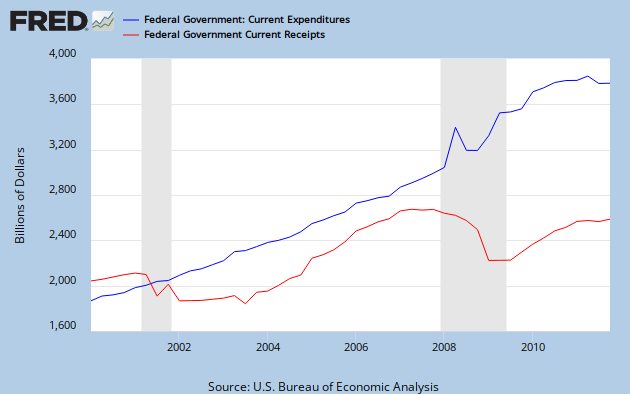
Romney fails to mention, however, three things. Firstly, after spiking to 10% for FY 2009, the deficit has been coming down -- though it's still higher than it used to be. (The red column is a projection based on this year's budget.) Secondly, presidents don't get to start their terms with a clean slate. Instead, they inherit the economic situation left behind by the former president. This is why the graph shows a surplus for Bush's first year -- FY 2001. Thirdly, the deficit is not simply a function of spending. It also involves revenues from taxes, and those plunged when we hit the recession, and they've get to recover to their pre-recession high.

From the Federal Reserve Bank of St. Louis

Spending has flattened, and revenues are beginning to pick up. But there's an argument -- okay, several arguments -- that this is a bad thing. To understand this, we need to remember that while the federal government can take counter-cyclical measures to combat a recession, states can't (and which is why our calls for a new stimulus package include compensatory aid to the states), as they are required to balance their budgets. So while the federal government has increased spending, no small part of that was negated by a decrease by spending by the states.

From Jared Bernstein (who takes his info from the BEA).

If state spending had no effect on GDP, we would have seen growth for the last quarter at 3.1% instead of the 2.8%. It's not a huge difference, but right now every tenth of a percent counts.

And, as Paul Krugman notes, many of those cuts have occurred in investments.


 Paul continues:
We’re sacrificing the future as well as the present. Oh, and the cuts that aren’t falling on investment in physical capital are largely falling on human capital, that is, education.
It’s hard to overstate just how wrong all this is. We have a situation in which resources are sitting idle looking for uses — massive unemployment of workers, especially construction workers, capital so bereft of good investment opportunities that it’s available to the federal government at negative real interest rates. Never mind multipliers and all that (although they exist too); this is a time when government investment should be pushed very hard. Instead, it’s being slashed.
What an utter disaster.
It is worth noting, though, that things would be much, much much worse if any of the Republican candidates were in actually in office right now.  All of Romney, Gingrich, Santorum and Paul support balanced budget legislation and, as we saw with state spending, balancing the budget during a recession is pro-cyclical -- it makes the recession worse.

Worser -- all of the Republican candidates are offering up tax plans with tax cuts that would make the deficit much worse. The Washington Post refers to Tax Policy Center calculations (but fails to provide a link) that Romney's plan would cost $180 billion, that Gingrich's plan would cost $850 billion, and that Santorum's plan would cost $900 billion — all for 2015 alone.

Ron Paul's plan was not scored by the Tax Policy Center, but according to his web site he would "[restrain] federal spending by enforcing the Constitution’s strict limits on the federal government’s power [to] help result in a 0% income tax rate for Americans." Presumably this would make the deficit worse, if the country were to survive.

Monday, January 23, 2012

What the Bain Gang Can Teach Us about Corporate Tax Reform

We need to kill the business interest deduction.

As we noted in our discussion about eliminating the mortgage interest deduction, interest has historically been tax deductible. In fact, it wasn't until 1986 that personal interest was not deductible -- thank you, astonishing growth in credit cards and personal debt -- though the mortgage interest deduction was preserved. 

But it's now time to think about whether business interest should be deductible at all, and one of the best arguments against it is courtesy of private equity concerns like Bain Capital.


First, though, how awesome is that picture.

Private equity is a bit of a catch-all term that includes things like venture capital (to get a company off the ground and running), mezzanine capital (providing additional capital to an existing company), and leverage buy-outs (see Gordon Gekko). 

When Romney has been talking about creating jobs, he's been talking about venture capital. When people talk about the companies killed by Bain Capital, they're talking about leveraged buy-outs.

In its simplest form, a leverage buy-out is a like a mortgage, where you use the asset you want to buy to secure the financing necessary to make the purchase. Josh Kosman explains to Mike Konzal:
JK: The whole industry started in the mid-to-late 1970s. The original leveraged buyout firms saw that there were no laws against companies taking out loans to finance their own sales, like a mortgage. So when a private equity firms buys a company and puts 20 percent down, and the company puts down 80 percent, the company is responsible for repaying that.
Now the tax angle is that the company can take the interest it pays on its loans off of taxes. That reduces the tax rate of companies after they are acquired in LBOs by about half. Banks, also realizing this tax effect, were willing to finance these deals. At the time, you could also depreciate the assets of the company you were buying — that’s not true today.
They saw that you could buy a company through a leveraged buyout and radically reduce its tax rate. The company then could use those savings to pay off the increase in its debt loads. For every dollar that the company paid off in debt, your equity value rises by that same dollar, as long as the value of the company remains the same.
MK: So the business model is based on a capital structure and tax arbitrage?
JK: Yes. It’s a transfer of wealth as well. It’s taking the wealth of the company and transferring it to the private equity firm, as long as it can pay down its debt.  It think it is real - the very early firms targeted industries in predictable industries with reliable cash flows in which they by and large could handle this debt. As more went into this industry, it became very hard to speak to the original model. Now firms are taken over in very volatile industries. And they are taking on debts where they have to pay 15 times their cash flow over seven years — they are way over-levered.
MK: The most common argument for why Bain Capital and other private equity firms benefit the economy is that they are pursuing profits. They aren’t in the business of directly “creating jobs” or “benefitting society,” but those effects occur indirectly through the firms making as much money as they can.
But even here, “profits” — how they exist, where they come from, and how they are timed — have a crucial legal and regulatory function. A recent paper from the University of Chicago looking at private equity found that “a reasonable estimate of the value of lower taxes due to increased leverage for the 1980s might be 10 to 20 percent of firm value,” which is value that comes from taxpayers to private equity as a result of the tax code. Can you talk more about this?
JK: That sounds about right. If you took away this deduction, you’d still have takeovers, but you’d have a lot less leverage and the buyer would be forced to really improve the company in order to make profits. I think that would be a great thing.
If you look at the dividends stuff that private equity firms do, and Bain is one of the worst offenders, if you increase the short-term earnings of a company you then use those new earnings to borrow more money. That money goes right back to the private equity firm in dividends, making it quite a quick profit. More importantly, most companies can’t handle that debt load twice. Just as they are in a position to reduce debt, they are getting hit with maximum leverage again. It’s very hard for companies to take that hit twice. 
So leveraged buy-outs aren't about turnaround artists, people who take failing companies, re-organize  them and get them back on track. Instead, it's financial engineering, just taking advantage of the tax code. As James Surowiecki at the New Yorker notes,

The rewards can be extraordinary: when Romney was at Bain, it supposedly earned eighty-eight per cent a year for its investors. But piles of debt also increase the risk that companies will go bust.
And:
[B]etween 2003 and 2007 private-equity funds took more than seventy billion dollars out of their companies. These dividends created no economic value—they just redistributed money from the company to the private-equity investors.
And the business interest deduction is exploited by other industries as well, most notably investment banking. When a bank raises money by selling more equity, it faces a couple of problems. The first is that the previous group of shareholders are generally not happy, as the percentage of their ownership of the bank has gone down. Secondly, when the bank pays dividends, those dividends are not tax deductible, which makes the company less profitable. 

Raising capital by issuing debt solves both those problems. Each shareholder's stake remains the same, and the disbursements to the bond holders get written off the taxes. This led to some of the banks, most notably Lehman Brothers, becoming grossly over-leveraged, by some estimates up to 44:1. This made Lehman Brothers a very profitable company when times were good, but almost insured that it would get pummeled in the (inevitable) event of an economic downturn.

But what does the leverage really mean? Let's walk though an example, using a somewhat higher leverage ratio of 50:1. 

At that ratio, you could put up $2 but would have $100 in purchasing power, with the remaining money being supplied by a bank. If you invested that in stock, and the stock's value went to $101, you'd have a return of 50% -- you initially put up $2, but now have $3. 

But leverage works the other way as well. If the value of the stock drops by 1% -- form $100 to $99 -- you've lost 50% of your equity. And if the stock drops another dollar, your finished. 

(For the sake of comparison, the Federal Reserve limits the leverage you can use to buy stock to 2:1 through Reg T. (although that ratio can increase to 3:1 once the purchase has settled. Still, not so bad.)

The business interest deduction certainly made sense some time ago, but the financial wizards have turned it into a real hazard. Getting rid of this tax break would't prevent leveraged buy-outs or raising capital through debt, but it would re-focus these efforts on making sure the companies themselves did well. Private equity firms, banks and other corporations would have more "skin in the game," and the tax disadvantage of raising capital through equity would disappear.

It's also worth remembering that, despite the crowing about corporate taxes, the percentage of pre-tax corporate income used to pay taxes has fallen dramatically over the last 50 years:

From Kevin Drum and the Federal Reserve of St. Louis.
And corporate tax as a percentage of all US tax revenue has fallen harder.

See page 68 of this 2010 Senate Committee on Finance report. And thank you,  Felix Salmon.
So if we're trying to get the deficit back under control, we should be looking seriously at making corporations pay their fair share as well. Eliminating the business interest deduction would be one step down that path.